
Aerospace manufacturing demands exceptional precision, reliability, and process consistency. Among the critical components that determine aircraft performance, fuel line systems require leak-proof connections, dimensional accuracy, and resistance to pressure and vibration.
Tube end forming technology has become an essential manufacturing solution for producing high-performance aerospace tubing. By replacing multiple secondary operations with controlled forming processes, manufacturers can achieve greater efficiency, repeatability, and product quality.
Why Tube End Forming Matters in Aerospace Manufacturing

Aerospace fuel and fluid transfer systems operate under demanding conditions. Traditional tube processing methods often require multiple forming and machining steps, increasing production time and the risk of dimensional variation.
Tube end forming machines simplify production by creating finished tube-end geometries directly through controlled deformation processes.
Typical forming operations include:
- Tube expanding
- Tube reducing
- Bead forming
- Precision flaring
- End sizing
- Sealing profile forming
These processes improve connection strength while maintaining tube integrity.
Common Aerospace Tube Components Manufactured bxy End Forming
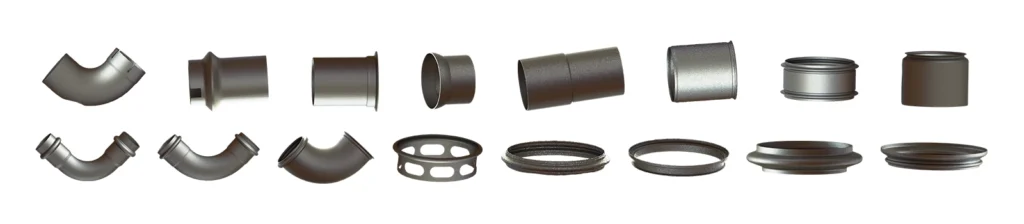
Modern aerospace production relies on end forming across various tube assemblies.
Fuel Delivery Tubes
Fuel systems require stable, leak-resistant connections capable of handling vibration and pressure fluctuations.
End forming ensures accurate flare angles and consistent sealing surfaces.
Hydraulic Fluid Lines
Aircraft hydraulic systems depend on controlled tube dimensions and repeatable assembly quality.
Precision forming improves fitting consistency.
Engine and Exhaust Tubing
Engine-related pipe systems require formed ends for clamp retention and thermal durability.
Beading and reducing operations support secure assembly.
Key Challenges in Aerospace Tube Processing
Manufacturing aerospace tubing presents several technical challenges.
High-Strength Material Forming

Common aerospace materials include:
- Titanium alloys
- Stainless steel
- Nickel-based alloys
These materials require stable clamping force and controlled forming pressure.
Tight Dimensional Tolerances
Aerospace applications demand:
- Consistent wall thickness
- Smooth surface finish
- Precise tube concentricity
- Repeatable dimensions
Advanced CNC-controlled forming minimizes variation.
How MAY11 Tube End Forming Machines Support Aerospace Applications
MAY11 develops tube end forming solutions designed to improve production efficiency and process consistency.
Key capabilities include:
Full Digital Control
Digital process management improves repeatability and supports standardized production.
High Precision Forming
Forming accuracy supports demanding industrial requirements and stable tube geometry.
Flexible Tooling Configuration
Quick tooling adjustment allows manufacturers to process different tube diameters and profiles.
Multi-Process Integration
Multiple forming operations can be completed in a single production cycle to reduce handling and improve throughput.
Benefits of End Forming Compared with Traditional Tube Processing
Manufacturers adopting modern end forming systems can achieve:
- Reduced production steps
- Lower material waste
- Improved consistency
- Higher productivity
- Better sealing performance
- Reduced labor dependency
The result is a more efficient and scalable manufacturing process.
How to Select the Right Tube End Forming Machine

Before selecting equipment, manufacturers should evaluate:
- Tube material
- Outer diameter range
- Wall thickness
- Required end profile
- Annual production volume
- Automation requirements
Matching machine capability with production goals helps maximize return on investment.
The Future of Aerospace Tube Manufacturing
As aerospace systems continue moving toward lightweight design and intelligent production, tube processing technologies are evolving rapidly.
Future manufacturing trends include:
- Servo-electric forming
- Robotic loading systems
- Real-time process monitoring
- Smart production integration
- Flexible automated work cells
Tube end forming will continue playing an important role in delivering efficient and reliable aerospace production.
Conclusion
Tube end forming technology is reshaping aerospace fuel line manufacturing by combining precision, automation, and process efficiency.
For manufacturers seeking reliable tube processing solutions, selecting advanced end forming equipment can improve product quality, reduce operational costs, and support long-term production growth.