
What Is a Multi Station Tube End Forming Machine?

A multi station tube end forming machine is an advanced industrial fabrication system designed to reshape and reconfigure the ends of metal tubes through a sequential, automated process. Unlike traditional single-stage equipment, these machines feature multiple forming stations integrated into a single chassis. This allows a single piece of tubing to undergo complex, multi-step tube end forming—such as expanding, reducing, flaring, and slotting—without the need to manually transfer the workpiece between different machines.
To achieve precise and highly repeatable tube end shapes, these systems rely on a robust combination of specialized mechanical components and advanced automation:
- Tube Clamping Mechanism: High-force hydraulic or pneumatic clamps secure the tube firmly in place, preventing slippage and ensuring axial alignment during intense forming pressures.
- Forming Tooling & Dies: Each station houses distinct forming dies, punches, or mandrels tailored to execute a specific geometry change.
- Hydraulic Forming Force: A heavy-duty hydraulic system delivers the massive, controlled force required to plastically deform materials ranging from aluminum and copper to stainless steel.
- CNC Control System: A centralized programmable logic controller (PLC) or CNC system manages the indexing of the stations, stroke depth, and pressure parameters to optimize overall cycle time.
By consolidating several manufacturing steps into one continuous operation, a multi station tube end former significantly boosts production efficiency and eliminates variance between batches. It is a critical asset for high-volume tube production environments where precision tolerances and rapid throughput are paramount.
How Does a Multi Station Tube End Former Work?

A multi station tube end forming machine automates complex, multi-step tube end forming into a single, continuous cycle. Instead of moving a part across multiple machines, this system sequences the tools automatically to deliver high-volume tube production with extreme precision.
The standard operating sequence relies on a mix of hydraulic power and smart automation:
- Secure Tube Clamping: The raw tube is loaded into the machine—frequently via automatic loading and unloading systems—and locked tightly by heavy-duty tube clamping dies to prevent any slipping.
- Station Indexing: The machine’s multiple forming stations shift smoothly into position, aligning the first stage of forming tooling with the tube end.
- Hydraulic Precision Strike: A powerful hydraulic forming force drives the forming die or mandrel into the tube, executing the first precise shape change based on the specific tube diameter, wall thickness, and tube material.
- Sequential Progression: The CNC control system automatically indexes to the next station, repeating the process with different dies to finish complex geometries without ever releasing the workpiece.
This automated progression slashes cycle time and boosts overall production efficiency, yielding perfectly repeatable tube end shapes every single run.
Single Station vs Multi Station Tube End Forming Machine
Choosing between a single station and a multi station tube end forming machine comes down to your production volume and the complexity of the part. If your process requires multi-step tube end forming to achieve the final shape, a single-station setup will slow you down.
Here is how the two configurations stack up against each other in real-world production:
Key Differences at a Glance
| Feature | Single Station Machine | Multi Station Tube End Forming Machine |
|---|---|---|
| Forming Steps | One shape per cycle | Multiple forming stations in one cycle |
| Tooling Setup | Single forming die and clamp | Multiple dies, punches, or a mandrel turret |
| Production Volume | Low to medium batch runs | High-volume tube production |
| Cycle Time | Slower (requires manual tool changes for complex shapes) | Fast (seamless indexing between stations) |
| Labor Costs | Higher per part for complex geometries | Lower due to automated multi-step processing |
Why Upgrade to a Multi Station Setup?
- Eliminate Manual Handling: A single station machine forces operators to change out the forming tooling or move the pipe to a different machine to complete a complex profile. A multi station tube end forming machine finishes the job in a single clamping cycle.
- Superior Accuracy: Every time a tube is unclamped and moved, you risk misalignment. Multiple stations share a rugged tube clamping system, ensuring highly repeatable tube end shapes.
- Boosted Efficiency: Heavy-duty hydraulic forming force and advanced CNC control system integration allow multi-station machines to cycle through indexing, expanding, and reduction steps in seconds, drastically cutting down your total cycle time.
Common Processes: Expanding, Reducing, Flaring and Beading
A multi station tube end forming machine handles a variety of complex shapes in a single continuous cycle. By utilizing customized forming tooling and distinct forming die setups at each station, these machines reshape tube ends with extreme precision.
The four primary operations performed by a multi station tube end former include:
- Tube Expanding: Increases the tube diameter to allow another tube to slip inside, which is essential for slip-fit joints in exhaust systems.
- Tube Reducing: Swages or shrinks the outer diameter of the tube end, making it easier to connect to smaller hoses or components.
- Tube Flaring: Creates a conical flare at the lip of the tube, a critical requirement for high-pressure hydraulic fittings and leak-free fluid lines.
- Tube Beading: Forms a raised ridge or bump near the end of the tube, which acts as a mechanical stop or a securing lip to prevent hoses from slipping off under pressure.
Process Comparison Table
| Process | Primary Tooling Used | Main Application | Key Benefit |
|---|---|---|---|
| Expanding | Expanding segment punch / Mandrel | Slip-fit connections | Precise internal diameter control |
| Reducing | External reducing die | Hose attachments & adaptors | Smooth outer diameter transitions |
| Flaring | Conical flaring punch | Hydraulic & fuel lines | High-pressure, leak-free sealing |
| Beading | Internal/External bead dies | Automotive & coolant lines | Prevents hose slippage |
Executing these multi-step tube end forming processes on a single multi station tube end forming machine eliminates the need for separate machines. This consolidation drastically reduces cycle time, protects the tube material from work hardening between steps, and ensures highly repeatable tube end shapes for high-volume tube production.
2 Station vs 3 Station Tube End Forming Machine
When choosing a multi station tube end forming machine, the debate usually comes down to picking a 2 station or a 3 station setup. Both deliver incredible production efficiency, but the right choice depends entirely on how complex your multi-step tube end forming process needs to be.
Here is a quick breakdown to help you decide which configuration fits your floor:
| Feature | 2 Station Tube End Former | 3 Station Tube End Former |
|---|---|---|
| Forming Steps | Up to 2 consecutive operations | Up to 3 consecutive operations |
| Complexity | Simple to moderate shapes | Highly complex, multi-stage geometries |
| Cycle Time | Faster for basic jobs | Slightly longer per part, but saves secondary setups |
| Tooling Capacity | Holds 2 sets of forming die sets | Holds 3 sets of forming tooling or a mandrel |
The 2 Station Setup: Speed and Simplicity
A 2 station multi station tube end forming machine is the go-to for high-volume, standard jobs. If you need to clamp the tube once, do a quick expanding step, and follow it up with a final reduction or flare, this is your machine. It offers a faster cycle time for everyday geometry and keeps your footprint and initial investment lower while maintaining perfect, repeatable tube end shapes.
The 3 Station Setup: Maximum Formability
When a part requires aggressive material displacement, a 3 station machine is necessary. Trying to force a severe change in tube diameter or wall thickness in just one or two hits can split the tube material. The third station allows for a critical pre-forming stage.
- Station 1: Pre-form or initial expansion.
- Station 2: Intermediate sizing or specialized beading.
- Station 3: calibration or finishing flare.
For high-volume tube production involving complex architectural, automotive, or HVAC components, a 3 station machine eliminates the need to move parts to a second machine, keeping your workflow completely streamlined under a single CNC control system.
Applications of Multi Station Tube End Forming Machines
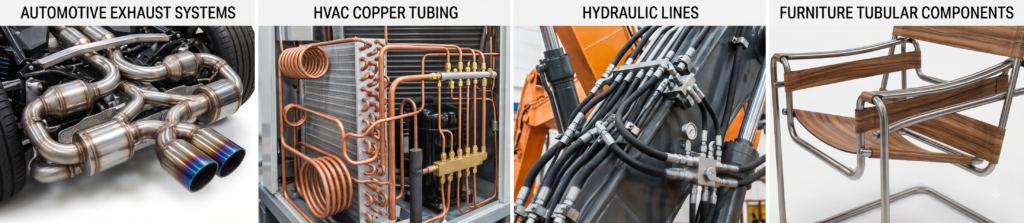
In high-volume tube production, efficiency and precision are non-negotiable. We design our multi station tube end forming machine lineup to handle complex, multi-step tube end forming processes in a single cycle. By moving a part through multiple forming stations, industries can eliminate manual handling, slash cycle times, and achieve highly repeatable tube end shapes.
From automotive assembly lines to HVAC manufacturing, here is where our machinery delivers the highest return on investment.
Key Industries Utilizing Multi-Station Formers
Automotive and Exhaust Systems
The automotive sector demands high production efficiency and strict adherence to tight tolerances. Our machines excel at shaping structural and fluid-handling components:
Exhaust Pipes: Creating precise expansions and reductions for seamless slip-joint assembly.
Cooling and Fuel Lines: Forming specific beads and flares on thin-walled aluminum or steel lines to ensure leak-proof connections.
Chassis Components: Heavy-duty shaping of thick-walled structural tubes using high hydraulic forming force.
HVAC and Refrigeration
In heating and cooling manufacturing, leak prevention is critical. Copper and aluminum tubing require precise, repeatable manipulation to ensure tight seals.
Manifolds and Distributors: Utilizing multi-step forming to expand, reduce, and flare tube ends for brazing.
Heat Exchangers: Rapidly expanding tube ends to match specific connector sizes without compromising the tube material integrity.
Aerospace and Fluid Power
High-pressure environments require flawless components. Our CNC control system integration ensures that every part meets rigid aerospace standards.
Hydraulic Lines: Creating heavy-duty flares and specialized shapes on rigid lines.
Fuel Delivery Systems: Processing tough materials like stainless steel and titanium while maintaining uniform wall thickness.
Common Applications at a Glance
| Industry | Common Component | Primary Forming Process | Material Used |
|---|---|---|---|
| Automotive | Exhaust tailpipes, EGR tubes | Expanding, Reducing | Stainless Steel, Aluminized Steel |
| HVAC | Condenser lines, Heat exchangers | Flaring, Beading, Expanding | Copper, Aluminum |
| Furniture | Metal chair frames, Desk legs | Tapering, Swaging | Carbon Steel |
| Aerospace | High-pressure fluid lines | Precision Flaring | Titanium, Stainless Steel |
Why High-Volume Manufacturers Choose Multi-Station Setups
The Bottom Line: If your production requires a tube to be expanded, then flared, and finally beaded, doing this on single-station machines creates massive bottlenecks.
By integrating automatic loading and unloading systems with our multi-station equipment, your workshop can transition from raw stock to a finished, multi-shaped component in seconds. This drastically reduces labor costs, eliminates work-in-progress inventory, and maximizes your daily output.
How to Choose the Right Multi Station Tube End Former

Selecting the right multi station tube end forming machine directly impacts your production efficiency and manufacturing capabilities. To get the best return on investment, you need to match the machine specs with your specific application needs.
Here is the quick checklist we use to evaluate and choose the ideal custom tube end forming machine:
Key Selection Criteria
- Material Compatibility: Ensure the machine handles your specific tube material (stainless steel, aluminum, copper, or carbon steel) without fracturing.
- Tube Dimensions: Match the machine’s capacity with your maximum tube diameter and wall thickness.
- Production Volume: High-volume tube production requires automatic loading and unloading options to minimize cycle time.
- Tooling Changeover: Look for quick-change forming tooling and forming die systems to reduce setup downtime.
Machine Selection Matrix
| Factory Requirement | Recommended Machine Setup | Key Features to Look For |
|---|---|---|
| High-Volume Parts | Fully Automatic Multi-Station | Automatic loading and unloading, fast cycle time, integrated cooling. |
| Complex Shapes | 3+ Station CNC Former | CNC control system, multi-step tube end forming, precision mandrel indexing. |
| Heavy-Wall Tubes | High-Tonnage Hydraulic Former | Robust tube clamping, massive hydraulic forming force, reinforced frame. |
| Mixed Batch Runs | 2-Station Quick-Change Former | Accessible multiple forming stations, modular forming die slots. |
Control and Precision
For complex geometries and tight tolerances, prioritize a CNC control system. A CNC setup ensures repeatable tube end shapes across thousands of runs, controlling the hydraulic forming force and stroke distance with extreme precision. If you run a high-mix shop, digital recipe storage saves hours of manual calibration during tool changes.
FAQ About Multi Station Tube End Forming Machines
What materials can a multi station tube end forming machine process?
Our machines easily handle a wide variety of industrial materials. You can process carbon steel, stainless steel, aluminum, copper, and brass. The exact capability depends on the tube diameter, wall thickness, and the tensile strength of the specific material.
How many forming steps can be done in one cycle?
A multi station tube end forming machine handles multiple steps in a single automated cycle. Depending on your configuration, a 2-station, 3-station, or multi-step setup moves the tube from one die to the next without manual intervention, cutting down cycle time significantly.
Can these machines integrate into automated production lines?
Yes. Our systems are built for high-volume tube production. They seamlessly connect with CNC control systems, robotic arms, and automatic loading and unloading equipment to maximize production efficiency.
What is the typical changeover time for forming tooling?
We design our forming die and tube clamping systems for quick changes. A standard tooling swap and machine calibration usually takes between 15 to 30 minutes, keeping your downtime minimal.
How does the machine ensure repeatable tube end shapes?
Precision comes down to the hydraulic forming force and rigid mechanical stops. Coupled with advanced sensors, the machine delivers identical pressure and depth on every stroke, ensuring perfect consistency across thousands of parts.
Is a mandrel required for all tube end forming processes?
Not always. A mandrel is essential when you need to prevent wrinkling or cracking during complex expansion or reduction. For simple flaring or beading, standard external clamping and punches are often enough.