
Tube end forming is a metal tube processing method used to reshape the end of a tube into a specific profile. Instead of changing the entire tube shape, the process focuses on the tube end, creating features such as flares, expansions, reductions, beads, grooves, flanges or custom profiles.
In industrial manufacturing, tube end forming is widely used when a tube needs to connect with another part, seal properly, improve strength, hold a hose, fit into an assembly or meet a precise engineering requirement. This process is common in automotive exhaust systems, HVAC copper tube production, aerospace fuel lines, furniture frames, hydraulic systems and general metal fabrication.
What Is Tube End Forming?
Tube end forming refers to the process of changing the shape of a tube end by applying controlled pressure through dies, punches, clamps and hydraulic or servo-driven systems. The machine holds the tube in position, then the forming tooling reshapes the tube end according to the required design.
The formed end may be larger, smaller, flared outward, grooved, beaded or shaped into a special profile. The goal is not only appearance. In most applications, tube end forming supports connection, sealing, assembly, flow control, durability or production efficiency.
For example, an automotive exhaust pipe may require an expanded end so another pipe can fit into it. An HVAC copper tube may need a flared end for connection. A hose connection may require a bead to prevent slipping. These are all typical tube end forming applications.
How Does the Tube End Forming Process Work?
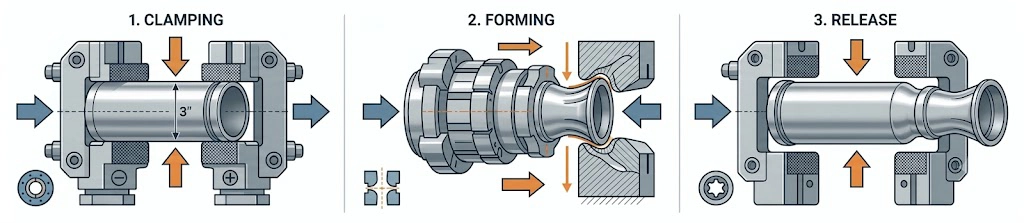
The tube end forming process usually includes several basic steps:
- The operator or automatic feeding system places the tube into the machine.
- The clamping system holds the tube firmly to prevent movement.
- The forming die or punch moves into position.
- Hydraulic, pneumatic or servo force reshapes the tube end.
- The finished tube is released for inspection or the next production step.
The exact process depends on the tube material, tube diameter, wall thickness, forming length and final profile. Stainless steel, carbon steel, aluminum and copper may all require different forming pressure, die design and cycle settings.
Common Types of Tube End Forming
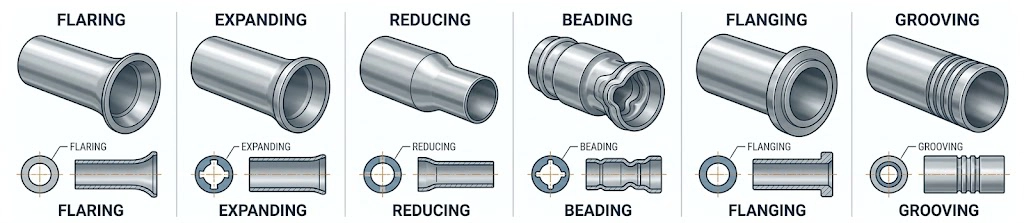
Tube end forming includes several common methods. Each method creates a different tube end shape for a specific industrial purpose.
Tube Flaring
Tube flaring expands the tube end outward into a cone-shaped or angled opening. It is often used when a tube needs to connect with fittings, seals or other components. Flaring is common in HVAC, refrigeration, automotive and fluid transfer applications.
Tube Expanding
Tube expanding increases the diameter of the tube end. This allows one tube to fit over another tube or into an assembly. It is frequently used in exhaust systems, heat exchangers and industrial pipe connections.
Tube Reducing
Tube reducing makes the tube end smaller. This process is useful when a tube must fit into a smaller connector, control flow or meet a compact assembly requirement. Reducing requires stable clamping and accurate tooling to prevent wrinkles or cracking.
Tube Beading
Tube beading creates a raised ring around the tube end. This bead helps secure hoses, improve sealing and prevent connected parts from slipping. It is common in fluid, air and automotive hose applications.
Tube Flanging
Tube flanging turns the tube end outward to create a flat or shaped edge. It can support sealing surfaces, mounting points or reinforced connections.
Tube Grooving
Tube grooving creates a recessed channel near the tube end. Grooves may be used for sealing rings, locking mechanisms or special assembly requirements.
Tube End Forming vs Tube Bending
Tube end forming and tube bending are different processes.
Tube bending changes the direction or curve of the tube body. Tube end forming changes the shape of the tube end. In many manufacturing lines, both processes may be used together. A tube can be bent first and then formed at the end, or formed first depending on the production sequence.
The key difference is the purpose:
| Process | Main purpose | Typical result |
| Tube bending | Changes tube direction or angle | Curved or angled tube |
| Tube end forming | Changes tube end profile | Flared, expanded, reduced, beaded or grooved end |
If your product needs a connection, seal, fitting or assembly feature at the tube end, a tube end forming machine is usually required.
What Is a Tube End Forming Machine?
A tube end forming machine is industrial equipment used to reshape the end of metal tubes through forming dies and controlled force. Depending on the design, the machine may perform expanding, reducing, flaring, beading, flanging, grooving or custom tube end forming operations.
A typical tube end forming machine includes:
- clamping system;
- forming cylinders or servo units;
- forming dies and punches;
- machine frame;
- control system;
- safety protection;
- optional automatic feeding or unloading system.
May11 tube end forming machines are built for B2B manufacturers that need stable tube processing for automotive, HVAC, aerospace and industrial applications.
How to Choose a Tube End Forming Machine
Choosing the right tube end forming machine depends on your tube specifications and production requirements. Before selecting a machine, manufacturers should confirm the following details:
- tube material;
- tube outer diameter;
- tube wall thickness;
- forming length;
- required end shape;
- production volume;
- cycle time target;
- manual or automatic operation;
- tooling requirements;
- available workshop space.
For small or medium tube applications, a compact machine may be enough. For larger tube diameters, thicker wall tubes or more complex profiles, a stronger machine with higher forming force and suitable tooling may be required.
May11 provides different tube end forming machine models for different forming requirements.
| Model | Suitable positioning | Typical use |
| May11 180 | Smaller or standard tube end forming needs | Automotive, HVAC, general tube processing |
| May11 280 | Medium-duty tube end forming | Industrial tubes and production lines |
| May11 480 | Heavy-duty tube end forming | Larger tube profiles and stronger forming requirements |
Where Is Tube End Forming Used?
Tube end forming is used across many industries because tubes often need to connect, seal or fit into larger assemblies.
Automotive Exhaust Pipes
HVAC Copper Tubes
Aerospace Fuel Lines
Industrial Metal Fabrication
Industrial manufacturers use tube end forming for furniture, frames, hydraulic parts, machinery, pipe assemblies and custom metal components. The process helps improve connection quality and reduce secondary processing.
Common Tube End Forming Defects
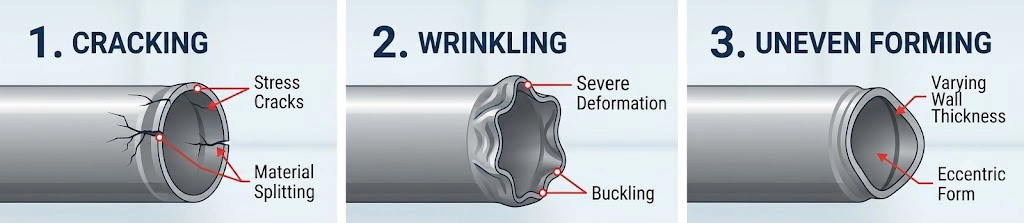
If tooling, machine settings or material selection are not correct, tube end forming may cause defects. Common issues include:
- cracking at the tube end;
- wrinkling during reducing or expansion;
- uneven forming shape;
- poor sealing surface;
- excessive thinning;
- inaccurate forming length;
- unstable repeatability.
Most defects can be reduced by using proper tooling, correct clamping force, suitable forming speed and a machine matched to the tube material and wall thickness.
Tube End Forming FAQ
What is tube end forming used for?
Tube end forming is used to create shaped tube ends for connection, sealing, assembly, hose retention, flow control and structural requirements.
What materials can be used for tube end forming?
Common materials include stainless steel, carbon steel, aluminum, copper and other metal tubes. The correct machine and tooling depend on material strength, tube diameter and wall thickness.
What is the difference between tube flaring and tube expanding?
Tube flaring creates an angled or cone-shaped opening at the tube end. Tube expanding increases the tube end diameter so it can fit over another tube or component.
Do I need a custom tube end forming machine?
You may need a custom machine if your tube profile, tooling, production volume or automation requirement cannot be handled by a standard machine.
How do I choose the right tube end forming machine?
Start with your tube material, diameter, wall thickness, end shape, production volume and cycle time target. Then choose a machine with suitable forming force, tooling design and automation level.
Conclusion
Tube end forming is an important process for manufacturers that need reliable tube connections, accurate end profiles and efficient production. From flaring and expanding to reducing, beading and grooving, the right tube end forming process can improve assembly quality and reduce production problems.
For manufacturers in automotive, HVAC, aerospace and industrial metal fabrication, choosing the right tube end forming machine is essential. May11 offers tube end forming machine solutions for different tube sizes, forming requirements and production needs.
If you are planning a new tube processing project, May11 can help evaluate your tube specifications, required forming profile and suitable machine model.