
The 8 Core Types of Tube End Forming Operations
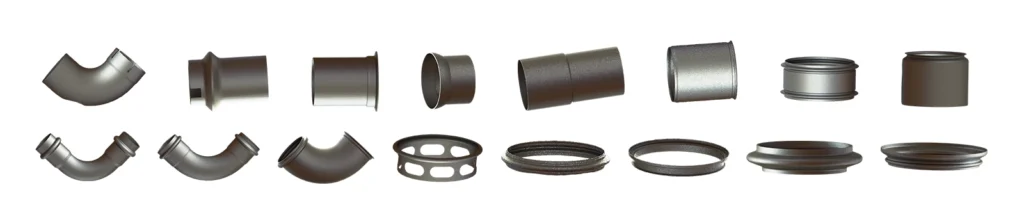
When you need high-precision connections, standard straight tubing rarely cuts it. Tube end forming is the process of shaping the ends of a tube using cold-flow deformation to prepare it for assembly, sealing, or mechanical joining.
Over years of handling B2B custom fabrication, we have mastered the core tube end-forming types required for high-performance global industries. Here is a breakdown of the essential operations we use to shape metal to your exact specifications.
Beading & Grooving
Beading creates a raised ridge around the circumference of the tube, while grooving presses a channel into it.
Primary Use: Retaining O-rings, securing hose connections, or acting as a mechanical stop.
Benefit: Increases structural rigidity at the joint without adding weight.
Flaring (37° and 45°)
Flaring expands the end of the tube into a funnel shape at a specific angle, typically 37° (AN/JIC standard) or 45° (SAE standard).
Primary Use: High-pressure hydraulic press tooling lines and fluid systems.
Benefit: Provides a leak-proof, metal-to-metal seal when compressed with a fitting.
Flanging (Van Stone Joints)
Flanging forms a 90-degree lip on the end of the tube, creating a flat surface perpendicular to the tube axis.
Primary Use: Loose, backing-flange assemblies (Van Stone joints) in piping networks.
Benefit: Allows for easy alignment and bolt-hole positioning during installation.
Expanding vs. Reducing (Swaging)
This operation alters the outer diameter (OD) of the tube end to allow for slip-fit assemblies.
Expanding: Increases the diameter so another tube can slide inside.
Reducing (Swaging): Decreases the diameter so it can slide into another tube or component.
Key Application: Essential for exhaust systems, HVAC plumbing, and structural frames.
Thickening
Also known as upsetting, thickening increases the wall thickness of the tube end while reducing its length or diameter.
Primary Use: Reinforcing heavy-duty structural parts before threading or welding.
Benefit: Counters the risks of wall thinning tolerances in high-stress areas.
Knurling
Knurling cuts or rolls a textured, cross-hatched pattern onto the exterior surface of the tube end.
Primary Use: Improving mechanical grip for press-fit plastic overmolding or rubber hose applications.
Benefit: Prevents the connected components from twisting or slipping out under pressure.
| Operation Type | Main Benefit | Common Industry |
|---|---|---|
| Beading & Grooving | Hose retention & O-ring seating | Automotive & HVAC |
| Flaring (37°/45°) | High-pressure, leak-proof seal | Hydraulics & Aerospace |
| Swaging (Expand/Reduce) | Perfect slip-fit nesting | Exhaust & Furniture |
| Thickening | Localized joint reinforcement | Heavy Machinery |
High-Performance Joint Configurations Explained
When standard connections won’t cut it, high-performance joint configurations ensure leak-free operation under extreme pressure, vibration, and temperature fluctuations. Through precise cold-flow deformation, these specialized shapes create robust, mechanical seals tailored for demanding automotive, aerospace, and industrial applications.
Marmon Bead and Flare
The Marmon bead and flare configuration is a staple in heavy-duty exhaust and turbo systems. By pairing a specific raised bead on one tube end with a matching flare on the mating tube, this joint creates a quick-connect structure secured by a V-band clamp. It allows for quick assembly and disassembly while maintaining a gas-tight seal under high vibrations.
Spherical Ball and Flare
For systems requiring angular misalignment flexibility, spherical ball joints provide the ultimate solution. The ball-shaped tube end nests perfectly inside a corresponding flare. This design allows the connection to pivot and self-align smoothly without sacrificing sealing integrity or restricting flow.
Norma Ball and Flare
Similar to the spherical design, the Norma ball and flare configuration is engineered for high-vibration automotive and exhaust systems. It offers a slightly different geometry optimized for rapid assembly lines. This joint provides excellent sealing performance and tolerates minor axial deviations during installation.
Slotted and Notched Ends
Not all configurations are meant for sealing fluids. Slotted and notched ends are used to facilitate slip-fit mechanical connections. By cutting precise slots or notches into the tube end, the metal gains the flexibility to compress slightly when a bracket or clamp is tightened over it, locking interlocking components firmly into place.
To see how these specialized configurations fit into a broader production workflow, check out our comprehensive what is tube end forming process guide for a breakdown of tools, machines, and core manufacturing applications.
Choosing the Right Machinery for Tube End Forming
Picking the right machinery changes everything when it comes to efficiency and part quality. We look at production volume, wall tolerances, and shape complexity to match the right method to the job. Here is how the three main options stack up in modern tube end-forming applications.
Segmented Sizers (Low-to-Mid Volumes)
Segmented machine sizers use expanding fingers or shrinking jaws to reshape the tube end. It is an ideal setup for short production runs because the tooling is affordable and quick to change. While it offers great flexibility for daily custom work, it leaves slight tool marks where the segments meet.
Progressive Ram Forming (High-Volume Precision)
For massive production runs requiring tight tolerances, progressive ram forming is our go-to choice. This process uses a powerful hydraulic press tooling system to force consecutive punch dies into or over the tube end. Each stroke brings the metal closer to its final shape via controlled cold-flow deformation, ensuring unmatched consistency across thousands of parts.
Rotary and Spin Forming (Complex Profiles)
When a project demands intricate, symmetrical shapes or ultra-smooth finishes, rotary end forming takes over. This method uses spinning rollers to manipulate the metal. It is highly effective for heavy-walled tubes and complex profiles because the rolling action prevents the material from cracking or wrinkling during forming.
| Machine Type | Ideal Volume | Best For | Key Advantage |
|---|---|---|---|
| Segmented Sizers | Low to Mid | Quick turnarounds, standard sizing | Low tooling costs |
| Progressive Ram | High | Strict wall thinning tolerances, high speed | Maximum consistency |
| Rotary / Spin | Mid to High | Complex profiles, heavy walls | Smooth finish, no tool marks |
Critical Material and Engineering Constraints
When we look at what is tube end forming, it is easy to focus only on the shapes we can create. However, the success of any cold-flow deformation process depends entirely on managing physical and material limits. If you ignore these constraints during custom fabrication, you risk part failure, cracked tooling, or weak joints.
Material Selection
Different metals react uniquely under hydraulic press pressure. Ductility—the material’s ability to stretch without tearing—is the main factor we consider.
- Stainless Steel: Offers high strength and corrosion resistance but requires massive force and causes fast tool wear.
- Aluminum: Lightweight and highly formable, though specific grades can crack if bent or expanded too aggressively.
- Copper and Brass: Highly ductile, making them perfect for complex flaring and swaging, but they harden quickly under stress.
The Threat of Wall Thinning

When you expand or flare a tube, you stretch the metal. This movement naturally reduces the wall thickness. If the wall thinning exceeds strict engineering tolerances, the joint will fail under high pressure. We carefully calculate the expansion ratios on our tube end forming machines to ensure the material stays within safe thickness boundaries.
Compensating for Metal Springback
Metal has memory. When our tooling releases a formed tube, the material naturally relaxes and springs back slightly toward its original shape.
| Material Type | Average Springback Tendency | Engineering Fix |
|---|---|---|
| Aluminum | Low to Medium | Precise over-bending |
| Carbon Steel | Medium | Calibrated tool pressure |
| Stainless Steel | High | Significant over-striking |
To achieve a perfect seal, our production process compensates for this metal springback by over-forming the piece by a calculated fraction of a degree or millimeter.
The Importance of Finishing
The process does not end when the shape is made. Tube fabrication services require proper finishing to eliminate stress concentration points. We ensure all ends are properly deburred and cleaned. Removing sharp edges and tiny imperfections prevents micro-cracks from spreading when the tube is placed under operational stress.
The Single-Facility Advantage: Integrating End Forming with Tube Fabrication

Handling tube end forming and tube fabrication under separate roofs is a recipe for production delays, shipping costs, and quality control headaches. When you partner with us, we eliminate those friction points. By integrating custom tube fabrication services with precision end forming in a single facility, we keep your entire project streamlined, accurate, and cost-effective from start to finish.
Timing the Process
Determining exactly when to shape the tube end makes or breaks the structural integrity of the final part. Depending on the geometry, end forming can happen before or after the bending stage:
- Pre-Bending Forming: Best for straight configurations where hydraulic press tooling needs a clean, unbent section of the tube to clamp onto securely.
- Post-Bending Forming: Necessary when the end design relies on the final bent orientation, though it requires specialized fixtures to protect the tube’s geometry.
Consolidating the Workflow
Managing multiple vendors introduces unnecessary risk into your supply chain. We consolidate the entire workflow to deliver major operational advantages:
| Stage | Process Monitored | Benefit to You |
|---|---|---|
| 1. Raw Material | Selection & Inspection | Zero baseline defects before shaping begins. |
| 2. Bending & Forming | Integrated CNC Tooling | Perfect alignment between the tube body and its geometric ends. |
| 3. Finishing & QA | Inline Inspection | Strict wall thinning tolerances and springback control. |
The May11 Approach
At May11, we treat end forming as an inseparable part of the broader fabrication cycle, not an afterthought. Our single-facility manufacturing setup utilizes progressive ram forming and segmented machine sizers right alongside our high-precision bending lines.
We control every variable—from cold-flow deformation limits to final tolerances—under one roof. If you are ready to streamline your supply chain and cut out secondary transit risks, explore our full capabilities on our products page, or reach out to our engineering team directly through our contact us page to discuss your project specifications.