
Tube end forming is a critical process for manufacturers that need strong, accurate and repeatable tube-end shapes for assembly, sealing or connection. For high-volume production, machines for ram tube end forming are widely used because they deliver powerful linear forming force, stable repeatability and efficient cycle times.
At May11, we design tube and pipe end forming machines for manufacturers working with stainless steel, carbon steel, aluminum, copper and brass tubes. Whether your project requires ram forming, segmented forming or rotary forming, choosing the right machine depends on your tube material, wall thickness, end profile, production volume and required tolerance.
What Are Machines for Ram Tube End Forming?
Machines for ram tube end forming use a straight-line forming motion to push a punch, die or forming tool into the end of a tube. This controlled force reshapes the tube end into the required profile, such as expanding, reducing, flaring, beading, swaging or necking.
Ram tube end forming is often used when the part requires:
- High forming force
- Repeatable tube-end dimensions
- Thick-wall tube processing
- Multi-step forming operations
- Tight tolerance production
- Automotive, HVAC, hydraulic or industrial tube applications
Compared with manual forming methods, ram forming machines provide better consistency and lower labor dependence, especially for medium- and high-volume production.
How Ram Tube End Forming Works
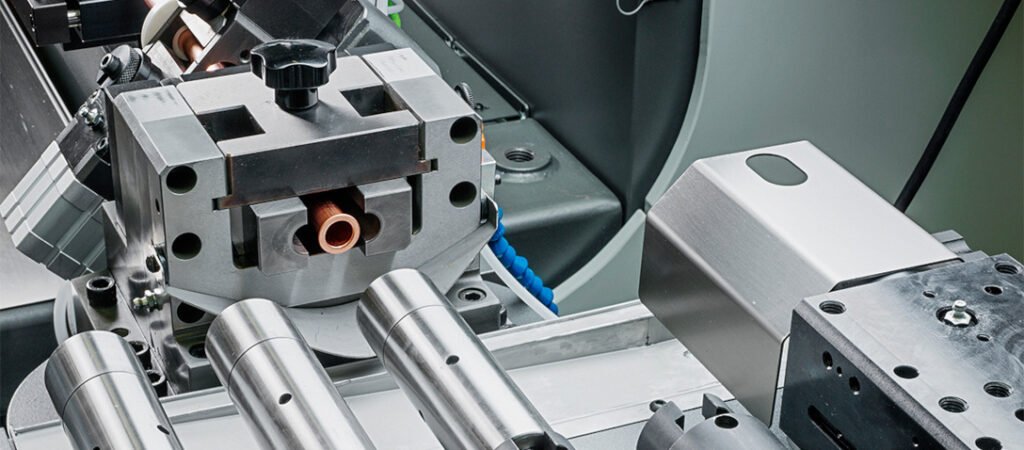
A typical ram tube end forming process includes several steps.
First, the operator or automatic loading system places the tube into the clamping area. The clamping dies hold the tube firmly to prevent slipping or misalignment. Then the ram moves forward and drives the forming tool into or over the tube end. Depending on the tooling design, the machine can expand, reduce, flare, bead or swage the tube end.
After the forming stroke is complete, the ram retracts and the finished tube is unloaded. In multi-station machines, several forming steps can be completed in one cycle, reducing manual handling and improving part consistency.
Ram Tube End Forming vs Segmented Tube End Forming
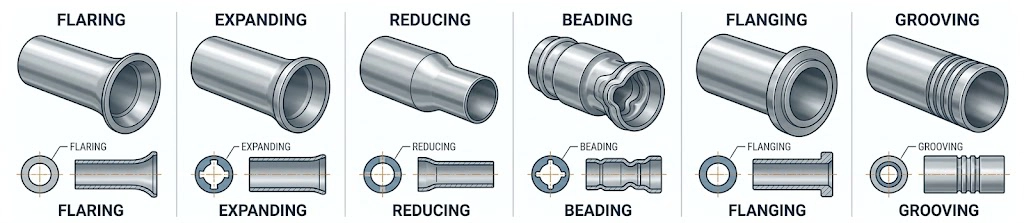
Many buyers compare machines for ram tube end forming with machines for segmented tube end forming. Both methods are useful, but they serve different production needs.
Ram tube end forming is better for strong linear forming force, deep forming strokes and repeatable high-volume production. It is commonly used for heavy-duty tube ends, thick materials and parts that need stable geometry.
Segmented tube end forming uses multiple segmented fingers or jaws to expand or reduce the tube end from several directions. It is often useful for sizing, calibration and flexible tube diameter adjustment. If your production requires frequent size changes or controlled expansion with less tooling cost, segmented tube end forming can be a practical option.
For many factories, the best solution depends on the actual tube drawing. May11 engineers usually review the tube outside diameter, wall thickness, material grade, forming shape and tolerance before recommending ram forming, segmented forming or a combined system.
When to Choose Machines for Segmented Tube End Forming
Machines for segmented tube end forming are suitable when the tube end needs controlled expansion, reduction or sizing through multiple contact points. This method is commonly used for parts that require smooth diameter adjustment and flexible tooling.
Segmented machines are often a good fit for:
- Low-to-medium production volumes
- Custom tube fabrication
- Diameter sizing and calibration
- Copper, aluminum and mild steel tubes
- Applications where tooling flexibility matters
- Projects with multiple tube sizes
If you are comparing segmented tube end forming machines for sale, do not only compare price. Check the machine’s clamping accuracy, segment durability, adjustment range, tooling change time and whether the supplier can support custom tooling.
Rotary Tube End Forming Machines for Sale: When Are They Useful?
Some tube-end profiles require gradual material flow rather than a single direct forming stroke. In these cases, buyers may look for rotary tube end forming machines for sale.
Rotary tube end forming machines use rotating tools or rollers to shape the tube end gradually. This can help reduce cracking, improve surface finish and control wall thinning. Rotary forming is especially useful for symmetrical profiles, smooth rounded ends and materials that need gentle forming.
Rotary tube end forming may be suitable for:
- Complex end profiles
- Smooth surface requirements
- Thin-wall tube applications
- Heavy-wall tubes that need gradual forming
- Stainless steel, aluminum or copper tube components
- Automotive, aerospace and fluid system parts
For buyers, the key is to confirm whether rotary forming is truly required. If the tube end shape can be produced more efficiently by ram forming, a ram tube end forming machine may offer better cycle speed and lower tooling complexity.
Tube and Pipe End Forming Machines for Different Applications
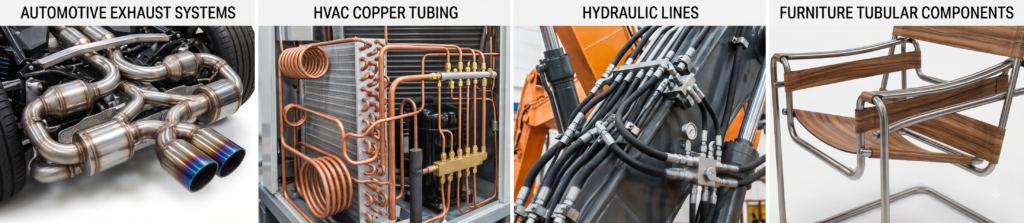
Modern tube and pipe end forming machines are used across many industries. The right machine configuration depends heavily on the final product.
In the automotive industry, tube end forming machines are used for exhaust pipes, fuel lines, brake lines, air-conditioning tubes and structural tube assemblies. These parts often require tight dimensional control and stable production repeatability.
In HVAC and refrigeration, tube end forming is used for copper tube expansion, flaring, reducing and manifold connections. Smooth forming and leak-free joints are especially important.
In hydraulic systems, formed tube ends must handle pressure, vibration and sealing requirements. Flaring, beading and swaging are common operations.
In furniture, construction and custom metal fabrication, tube end forming helps create slip-fit joints, decorative ends, structural connections and assembly-ready tube components.
Key Factors When Buying Tube End Forming Machines
Before choosing a machine, buyers should prepare the following information.
Tube material is the first factor. Stainless steel usually requires higher forming force than copper or aluminum. Carbon steel, brass and coated steel also behave differently during forming.
Tube outside diameter and wall thickness are equally important. Larger diameters and thicker walls require stronger machine structure, higher forming force and more durable tooling.
The required end shape determines the tooling and machine type. Expanding, reducing, flaring, beading, swaging, grooving and necking may require different forming methods.
Production volume also matters. Small-batch custom work may use a semi-automatic machine, while high-volume production may require CNC control, multi-station tooling or automatic loading and unloading.
Finally, tolerance requirements should be discussed early. If the part needs tight repeatability, the machine should have stable clamping, precise stroke control and reliable tooling alignment.
Why Work With a Tube End Forming Machine Manufacturer?
Working directly with a tube end forming machine manufacturer helps reduce selection mistakes. A general trading company may only compare model names, but an experienced manufacturer can evaluate the forming process behind the part.
May11 supports buyers by reviewing tube drawings, material specifications, diameter, wall thickness, target profile, production speed and automation needs. Based on this information, we can recommend a practical machine configuration, including ram forming, segmented forming, rotary forming, hydraulic control, CNC control or multi-station forming.
A reliable manufacturer should be able to answer questions such as:
- What forming method is best for this tube profile?
- Will the material crack during expansion or flaring?
- How much forming force is required?
- Is one station enough, or does the part need multi-step forming?
- What tooling material is recommended?
- Can the machine support future product changes?
- What maintenance does the machine require?
These answers are important because the cheapest machine is not always the lowest-cost solution. A poorly matched machine can lead to tool wear, unstable dimensions, high scrap rates and production delays.
May11 Tube End Forming Solutions
May11 provides tube and pipe end forming machines for manufacturers that need practical, durable and production-ready equipment. Our solutions can support ram tube end forming, segmented forming, rotary forming, hydraulic forming, CNC forming and automatic production requirements.
Our machines are designed for common forming operations such as:
- Tube expanding
- Tube reducing
- Tube flaring
- Tube beading
- Tube swaging
- Tube necking
- Tube sizing
- Custom tube-end profiles
For custom projects, May11 can help match the machine structure and tooling design to the actual production requirement instead of forcing every buyer into the same standard model.
FAQ About Machines for Ram Tube End Forming
What are machines for ram tube end forming used for?
Machines for ram tube end forming are used to reshape tube ends through a controlled linear forming stroke. They are commonly used for expanding, reducing, flaring, beading, swaging and other tube-end profiles.
What is the difference between ram and segmented tube end forming?
Ram tube end forming uses direct linear force from a ram and punch. Segmented tube end forming uses multiple segmented jaws or fingers to expand, reduce or size the tube end from several contact points.
Are segmented tube end forming machines for sale suitable for custom fabrication?
Yes. Segmented tube end forming machines for sale can be suitable for custom fabrication, especially when the work involves different tube sizes, low-to-medium production volumes or flexible sizing requirements.
When should I choose rotary tube end forming machines for sale?
Rotary tube end forming machines for sale are useful when the tube profile requires smooth surface finish, gradual material flow or reduced risk of cracking and wrinkling.
How do I choose the right tube end forming machine manufacturer?
Choose a tube end forming machine manufacturer that can review your tube drawing, material, diameter, wall thickness, end profile, tolerance and production volume before recommending a machine.
Conclusion
Choosing between machines for ram tube end forming, machines for segmented tube end forming and rotary tube end forming machines depends on your production goal. Ram forming is strong and efficient for repeatable linear forming. Segmented forming offers flexibility for sizing and custom tube diameters. Rotary forming is useful for smooth, complex and gradual tube-end shaping.
May11 helps manufacturers select the right tube and pipe end forming machines based on real engineering requirements. If you are looking for segmented tube end forming machines for sale, rotary tube end forming machines for sale or a custom ram tube end forming solution, send us your tube drawing, material, outside diameter, wall thickness and production volume. Our team will recommend a suitable machine and tooling configuration for your project.